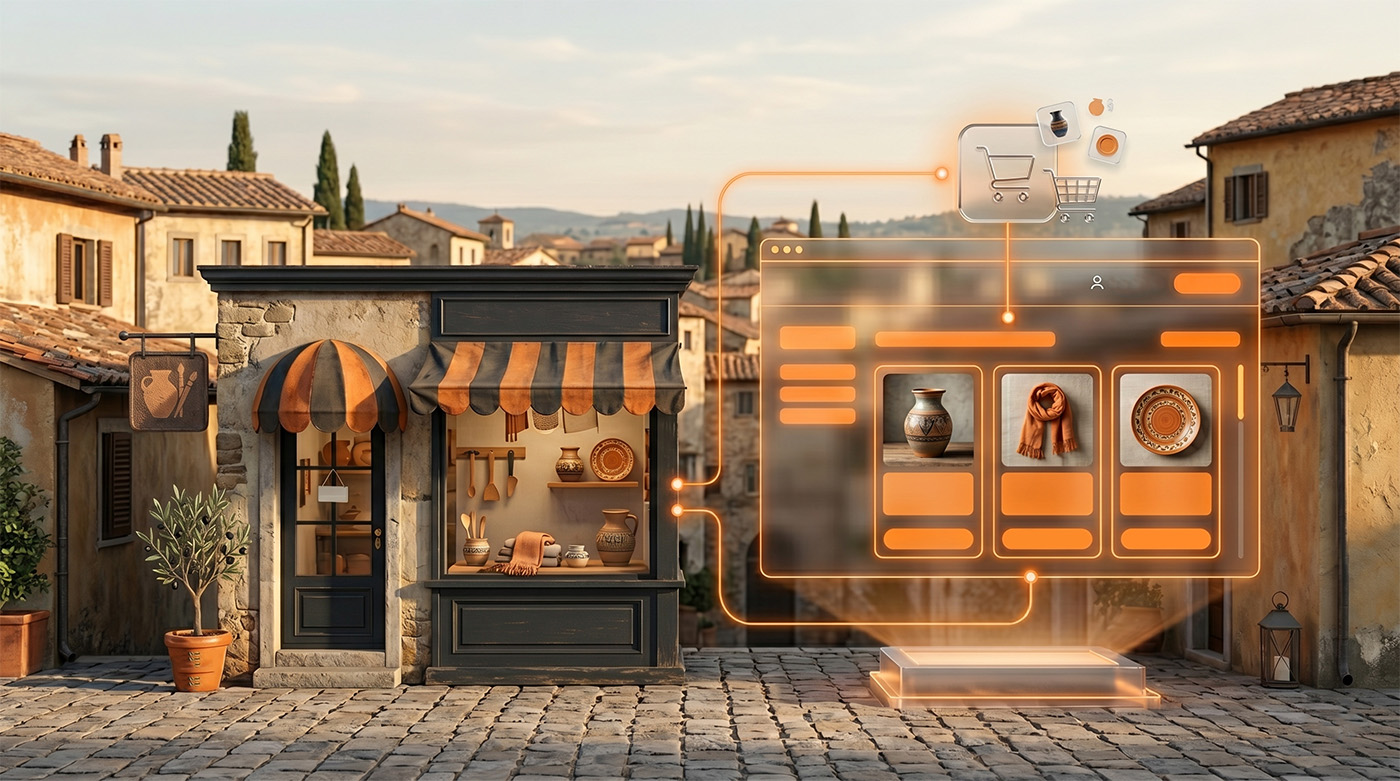
There is a craftsman in Pistoia who makes beautiful custom furniture. He works only through word of mouth and with people who walk past his workshop. When I asked him why he doesn’t sell online, his answer was: “My customers want to touch the wood.” True. But in the meantime his competitors, including some outside the province, are taking the inquiries of people who search Google for “custom furniture” before they ever set foot in a shop. Opening an e-commerce store in Pistoia in 2026 costs between €3,500 and €20,000, and for many local businesses it is no longer a luxury: it is the channel that reaches customers you don’t even know you are losing today.
In this guide I explain how much it really costs to build an e-commerce store in Pistoia, which platforms make sense for a small business, how long it takes to go live, and which mistakes we see over and over. Real numbers, no inflated promises.
How much it costs to open an e-commerce store in Pistoia in 2026
The prices we see in the area fall into three tiers, and the difference comes down to the number of products, the integrations and the level of customization.
Basic WooCommerce store (€3,500-8,000)
The typical solution for those just starting out: up to 100-150 products, an organized catalog, cart, card and PayPal payments, configured shipping, and a custom design built around your brand. It runs on WooCommerce, which is built on WordPress and is the most popular choice among small businesses in Italy. In this tier you get a serious store, ready to sell, with no unnecessary frills.
Advanced store with integrations (€8,000-15,000)
When your catalog grows (hundreds of products with variants), you need integrations with your business software, inventory sync, automatic electronic invoicing, multiple carriers and returns management. This is where most Pistoia businesses that already sell offline and want to bring real operations online end up. The website talks to your systems instead of living in isolation.
Custom or B2B store (€15,000-20,000 and up)
Customer-specific price lists, wholesale orders, reserved areas for resellers, product configurators, multiple languages for selling abroad. Typical of businesses that sell B2B or have non-standard requirements. It is a significant investment, but it builds an asset that works for you for years.
An honest caveat: these figures do not include advertising or monthly management. An e-commerce store with no traffic is a shop window with the lights off. If you want to understand why many online stores don’t sell despite the investment, we wrote an in-depth article on why your online store is not selling.
WooCommerce or Shopify: which platform to choose
It is the first question almost every small business asks us. There is no one-size-fits-all answer: it depends on how you sell and how much control you want.
- WooCommerce: maximum freedom and full ownership. No fees on sales, predictable running costs, unlimited customization. It does, however, require technical maintenance (updates, hosting, security). Ideal if you want a store that is truly yours and integrated with WordPress.
- Shopify: everything ready and managed for you, a fast start, fewer technical worries. In return you pay a monthly fee and, on some plans, a transaction fee. Ideal if you want to focus only on selling and less on the technical side.
In our experience, for Pistoia businesses that want control and low long-term costs, WooCommerce wins in most cases. Shopify makes sense for those who want to start tomorrow morning and don’t want to think about the technical side. We compared the two platforms in detail in WooCommerce or Shopify: which to choose.
How long it takes to build an e-commerce store
How long do you have to wait before you start selling? It depends less on the technology and more on how ready you are with products, photos and descriptions.
- Basic e-commerce store: 6-8 weeks from signing, if your product pages and images are ready.
- Advanced store with integrations: 10-14 weeks, because connections with business software and inventory require careful testing.
- Custom or B2B store: 16-24 weeks, depending on the complexity of the price lists and reserved areas.
The real bottleneck, as we always say, is the product pages. A hundred products means a hundred titles, a hundred optimized descriptions and consistent photos. Preparing this material in advance saves you weeks. A practical tip: start with your 30-40 best-selling products, launch, then expand the catalog once the store is live.
The most common mistakes when opening an e-commerce store
Working with local businesses, we see the same mistakes again and again. Here they are, so you can avoid them.
Thinking that publishing is enough to sell
Mistake number one. An e-commerce store that is online but has no traffic strategy (SEO, campaigns, email) is like a shop on a street with no passersby. Plan a budget for getting found from day one. We often suggest spending at least as much on promotion in the first year as you spent on building the store.
Underestimating photos and descriptions
Online, customers can’t touch the product: they judge it by the photos and the text. Dark images or descriptions copied from the supplier kill sales and also hurt your SEO. Investing in quality photography is one of the best returns there is for an online store.
Ignoring mobile
More than 70% of purchases start on a smartphone. A checkout that is awkward on a phone is money down the drain. Every serious e-commerce store should be designed with mobile in mind first, not as an afterthought.
If you want to see how we tackle these issues with local businesses, take a look at our Pistoia page or our dedicated e-commerce development service.
Is it worth selling online in Pistoia?
A fair question for anyone who has always worked face to face. The answer depends on the product, but the market is real. The province of Pistoia has about 290,000 residents, and a well-built e-commerce store does not stop at the province line: it sells across Italy and, if you want, abroad.
What we often see is this: local businesses with a distinctive product (crafts, food, furniture, niche products) are the ones that get the most value from the online channel, because online customers look for exactly what they can’t find around the corner. If your product has a strong identity, e-commerce won’t take customers away from your physical shop: it will bring you new ones you would never have reached.
In short
- Building an e-commerce store in Pistoia in 2026 costs from €3,500 (basic WooCommerce) to €20,000 and up (custom or B2B); the €8,000-15,000 range is the most common for businesses that already sell offline.
- WooCommerce offers control, ownership and predictable costs over time; Shopify offers a fast start in exchange for a monthly fee and transaction fees. For local small businesses, WooCommerce often wins.
- Timelines range from 6-8 weeks (basic) to 16-24 weeks (custom). The bottleneck is almost always product pages and photos.
- The costliest mistakes: thinking that publishing is enough to sell, underestimating photos and copy, and ignoring the mobile experience.
- For businesses with a distinctive product (crafts, food, furniture), e-commerce adds new customers from outside the province without taking away the ones who visit the physical shop.
Frequently asked questions
How much does it cost to open an e-commerce store in Pistoia?
A basic WooCommerce store with up to 100-150 products costs between €3,500 and €8,000. If you need integrations with business software, inventory and electronic invoicing, it rises to €8,000-15,000. Custom or B2B solutions with customer-specific price lists start at €15,000. On top of these costs you need a budget for promotion, which is essential to bring traffic to your store.
Is WooCommerce or Shopify better for a small business?
For most small businesses in Pistoia we recommend WooCommerce: no fees on sales, full ownership of your store, predictable costs and unlimited customization. Shopify suits businesses that want to get started very quickly without handling the technical side, accepting a monthly fee and possible transaction fees. The choice depends on how much control you want and on your running budget.
How soon can I start selling online?
A basic e-commerce store goes live in 6-8 weeks if your products, photos and descriptions are ready. With business software and inventory integrations, it takes 10-14 weeks. What stretches the timeline most is not the technology but preparing the product pages. Starting with your 30-40 best-selling products and expanding later speeds up the launch.
Will an e-commerce store take customers away from my physical shop?
In our experience the opposite happens: e-commerce reaches new customers, outside the province, who would never have walked into your shop. The online and in-store channels strengthen each other. Many customers discover a product online and then come to the shop, or, the other way around, check online before buying in person. They are two front doors, not a zero-sum game.
Do I have to handle shipping and payments myself?
Payments are set up once: cards, PayPal, bank transfer and, if you like, cash on delivery. Once configured, they run on their own. For shipping, carriers are integrated and labels and tracking are automated. Day-to-day work comes down to packing orders: the system does the rest. With your business software connected, invoicing becomes automatic too.
Want an honest quote for your e-commerce store?
We look at your products, your market and what you really need to sell online. Itemized costs, firm timelines, no surprises on the invoice. Free quote within 48 hours.
Request a quote