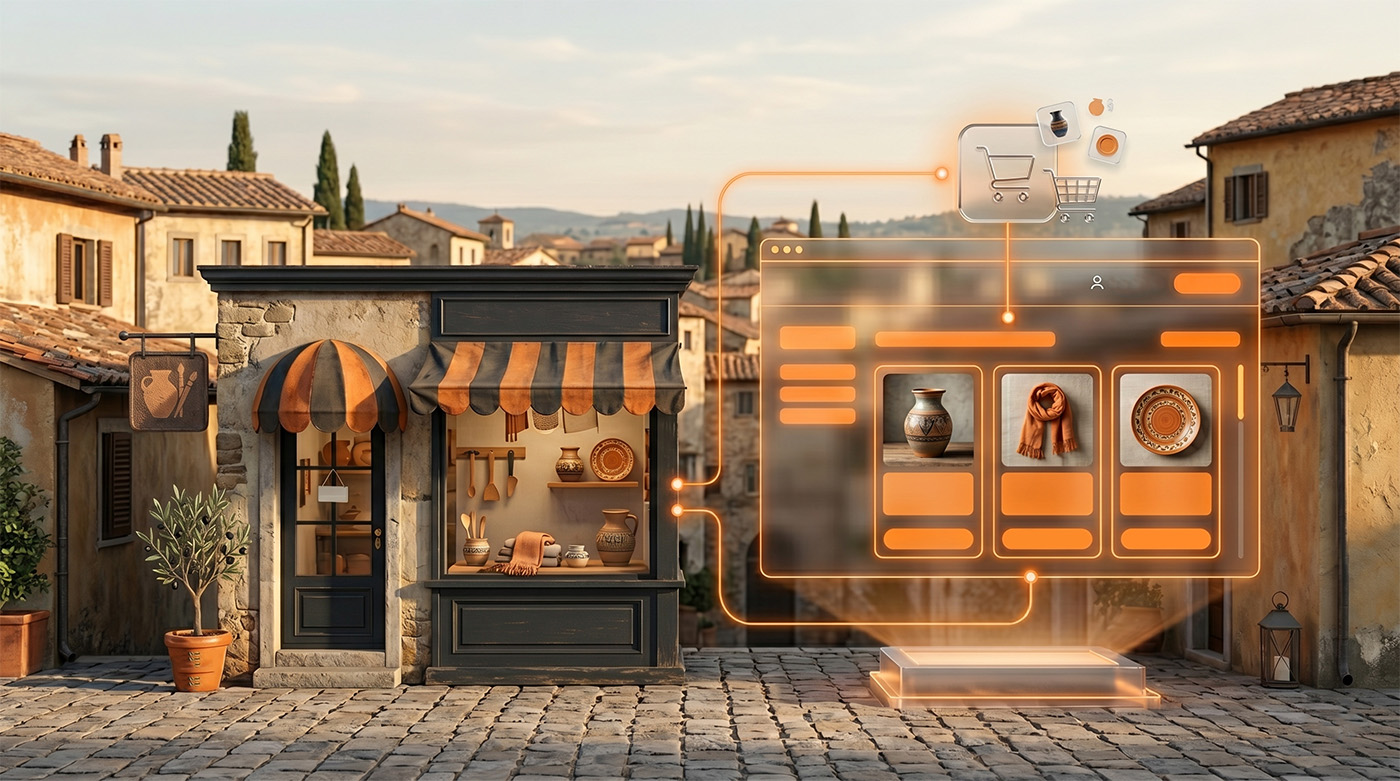
Everyone talks about business websites, brochure sites, e-commerce sites and so on. But what are the real differences? Which ones are most common in 2026? And above all, what type of website does your business need? More than 250,000 new websites go live around the world every day, and choosing the wrong type can cost you time, money and opportunities. This guide gives you a practical rundown of the 7 most common types of websites, what they cost, when each one makes sense and how to avoid mistakes.
The 7 most common types of websites in 2026
1. Brochure website
A brochure website is the digital version of a business card: a few pages (5-10) that tell people who you are, what you do and how to reach you. No shopping cart, no user accounts, no complex automation. It’s the right choice for professionals, small practices, craftspeople, restaurants, hotels and local businesses that want a serious online presence without paying for features they’d never use. Typical investment: €1,500-3,000. Build time: 3-5 weeks.
2. Corporate website
A more structured version of the brochure website, designed for medium-sized and large companies. It has 15-50 pages: a detailed About us section, company history, team, values, service or product pages, a news section, a press area, case studies and contact details for each location. It often includes a private client area or a partner portal. Typical investment: €5,000-15,000. Timeline: 6-12 weeks.
3. E-commerce
A website that sells products or services directly online: catalog, cart, checkout, order management, shipping carrier integration, payment systems. The most widely used platforms in Italy are WooCommerce (on WordPress), Shopify and PrestaShop. Investment: €5,000-15,000 for catalogs under 500 products, €15,000-50,000+ for more complex projects with business software integration, multiple warehouses or B2B. To learn more, visit our e-commerce development page.
4. Portfolio website
Designed for people who sell creativity or visual skills: photographers, designers, architects, illustrators, videographers, web agencies. The focus is on showcasing work beautifully, with high-resolution galleries, polished animations and detailed case studies. It’s often a brochure website too, just with more visual weight. Investment: €2,000-6,000. Timeline: 4-8 weeks.
5. Blog or editorial website
A website built around frequently publishing articles, news and guides. It’s the choice for content marketing, journalism and industry education. It often includes a newsletter, comments, categories and tags, and author pages. It generates organic traffic over time if the content is well crafted. Investment: €2,500-7,000. Timeline: 4-8 weeks. Slow but lasting ROI (12-18 months for the first significant SEO results).
6. One-page website or landing page
A single long page, optimized to lead visitors to one action: book, buy, sign up. Typical for a one-off event, a product launch or lead generation in ad campaigns. Investment: €800-2,500. Timeline: 1-3 weeks. Conversion rates are typically 2-5 times higher than on a regular website, but it needs traffic (Google Ads, social media) to work.
7. Web app or SaaS
It isn’t really a “website” but a web application that users actively interact with: business management software, CRMs, booking platforms, analytics tools, marketplaces, industry-specific apps. It has business logic, multiple user accounts, automation, API integrations and dashboards. Investment: €15,000-100,000+. Timeline: 3-12 months. For details, read our apps and business software page.
How to choose the right type for your business
The choice depends on three factors. First: what do you want the website to do? Generate leads (brochure), sell (e-commerce), inform and build authority (blog/corporate), or manage internal processes (web app)? Second: who is your target audience, and what device will they use? B2B customers read calmly on a desktop; B2C customers arrive on their smartphones in a hurry. Third: what’s your budget and timeline? A brochure website is a one-time cost, while an e-commerce site has ongoing costs (hosting, maintenance, integrations).
In our experience, the most common mistake is the “oversized website”: a small business with 20 customers a year convinces itself it needs e-commerce + a client portal + multiple languages + business software integration, when a clean brochure site with an effective contact form would have done the job. The wrong website doesn’t just cost too much; it distracts you from the things that would actually work.
How much each type of website costs (summary)
- Landing page / one-page: €800-2,500
- Brochure website: €1,500-3,000
- Portfolio website: €2,000-6,000
- Blog / editorial: €2,500-7,000
- Corporate website: €5,000-15,000
- E-commerce: €5,000-15,000 (mid-sized catalog) up to €50,000+ (enterprise projects)
- Web app / SaaS / business software: €15,000-100,000+ depending on complexity
On top of these, add recurring costs: hosting and maintenance with security updates (with us, these start at €300/year for websites and e-commerce; only web apps, business software or dedicated servers cost more) and your domain (€10-30/year).
Mistakes to avoid when choosing a type of website
Oversizing: starting out with advanced features you won’t use. Start with the bare minimum and grow over time. It’s cheaper to add a feature to a site you actually use than to pay for one that never gets used.
Underestimating SEO: whatever type of site you have, if it isn’t optimized for Google, it won’t bring in organic traffic. SEO isn’t “adding keywords to the copy”; it’s a series of technical choices (structure, speed, schema markup, internal links) that need to be made during development, not at the end of the project.
Ignoring mobile: more than 70% of website visits in Italy come from smartphones. A site that isn’t mobile-first starts out 50% behind on expected results.
Forgetting about maintenance: a website isn’t finished when it launches. Hosting, the SSL certificate, plugins, security updates and backups all need ongoing management. Without a maintenance plan, your site ages quickly and becomes vulnerable.
Key takeaways
- 7 types of websites in 2026: brochure, corporate, e-commerce, portfolio, blog, landing page, web app/SaaS.
- The choice depends on what the site needs to do, who your target audience is and what device they use, and your budget and timeline.
- Investment range: from €800 for a landing page to €100,000+ for complex web apps. Below these figures, the quality risk is high.
- Most common mistakes: oversizing, ignoring SEO and mobile, forgetting ongoing maintenance.
- Small businesses often start with a website that’s too big and pay for features they’ll never use. Start with the bare minimum and scale up later.
Frequently asked questions
What’s the most common type of website in Italy in 2026?
Brochure websites account for about 55% of new builds, followed by e-commerce (22%) and corporate websites (15%). Web apps and SaaS, though fewer in number, generate the largest share of revenue for development agencies because the projects are so complex.
Is WordPress right for every type of website?
WordPress handles brochure sites, corporate sites, blogs and small-to-medium e-commerce (via WooCommerce) very well. For a single landing page it’s overkill; dedicated tools (Unbounce, Carrd, Webflow) are better. For complex web apps and SaaS, WordPress becomes a limitation: dedicated frameworks like Laravel, Django or Node.js are a better fit. The choice of platform should follow the type of site, not the other way around.
Can I switch from a brochure website to e-commerce later?
Yes, but it rarely pays to “bolt” an online store onto an existing brochure site: it’s often faster and cleaner to rebuild the structure while keeping your domain, content and brand. The cost of the switch is similar to a new e-commerce site, but it avoids the technical compromises of a platform pushed beyond its original purpose.
How long does a website last before it’s “old”?
Technically, 3-5 years: after that, front-end technologies, user expectations and SEO standards change enough to call for a significant redesign. Visually, even 2 years can be enough in highly competitive industries (fashion, food, design). A well-built, well-maintained site can stay effective for 5-7 years with small, gradual updates instead of complete rebuilds.
How much does SEO matter when choosing a type of website?
A lot. A well-optimized blog generates organic traffic for years from a modest initial investment. A brochure website with no SEO strategy brings in zero organic traffic: it only works if you have other acquisition channels (referrals, social media, advertising). If your business model depends on Google traffic, whatever type of site you choose needs to be designed with SEO in mind from the start, not bolted on afterward.
Not sure which type of website you really need?
Tell us what your business does and what you want to achieve. Within 48 hours we’ll send you a concrete proposal with the type of website we recommend, the cost, the timeline and what you can realistically expect.
Request a free proposal